About MyChinese
MyChinese is designed for the moment Chinese study stops feeling academic and starts feeling lived. Instead of pushing every learner through the same fixed curriculum, the product turns the content they already care about into a more personal way into the language.
Role
Lead studio — brand direction, product UX/UI, and case-study storytelling.
Engagement
Released · 2026
- Client
- MyChinese
- Sector
- Education · Mobile App
- Year
- 2026
- Region
- Global
- Scope
- Brand direction · product UX/UI
- Deliverables
- Visual system · case-study layout
Beyond the word list.Designing for Chinese as it is actually lived.
At the heart of MyChinese is a simple shift: move the learner out of the classroom mindset and into the language as it actually appears in the world. Rather than forcing everyone through a rigid, pre-written curriculum, the app begins with curiosity. A video, an article, a scene from a drama, a line that catches your ear. Whatever draws you in becomes the start of a more personal route into Chinese.
That changes the first and most stubborn frustration in language study: the gap between textbook exercises and real-world material. MyChinese turns unfamiliar sentences into interactive lessons. Tap a word, hear a natural pronunciation, understand it in context, and keep moving. The experience is built so learning can happen inside stories, videos, and media people genuinely want to spend time with, not in detached example sentences that never leave the page.
From there, the app is designed to make discovery stick. Useful words can be saved instantly, then resurfaced through a review rhythm that works in the background, bringing them back just as memory begins to fade. It focuses attention where recall is weakest, eases off where mastery is already forming, and turns scattered moments of recognition into something cumulative.
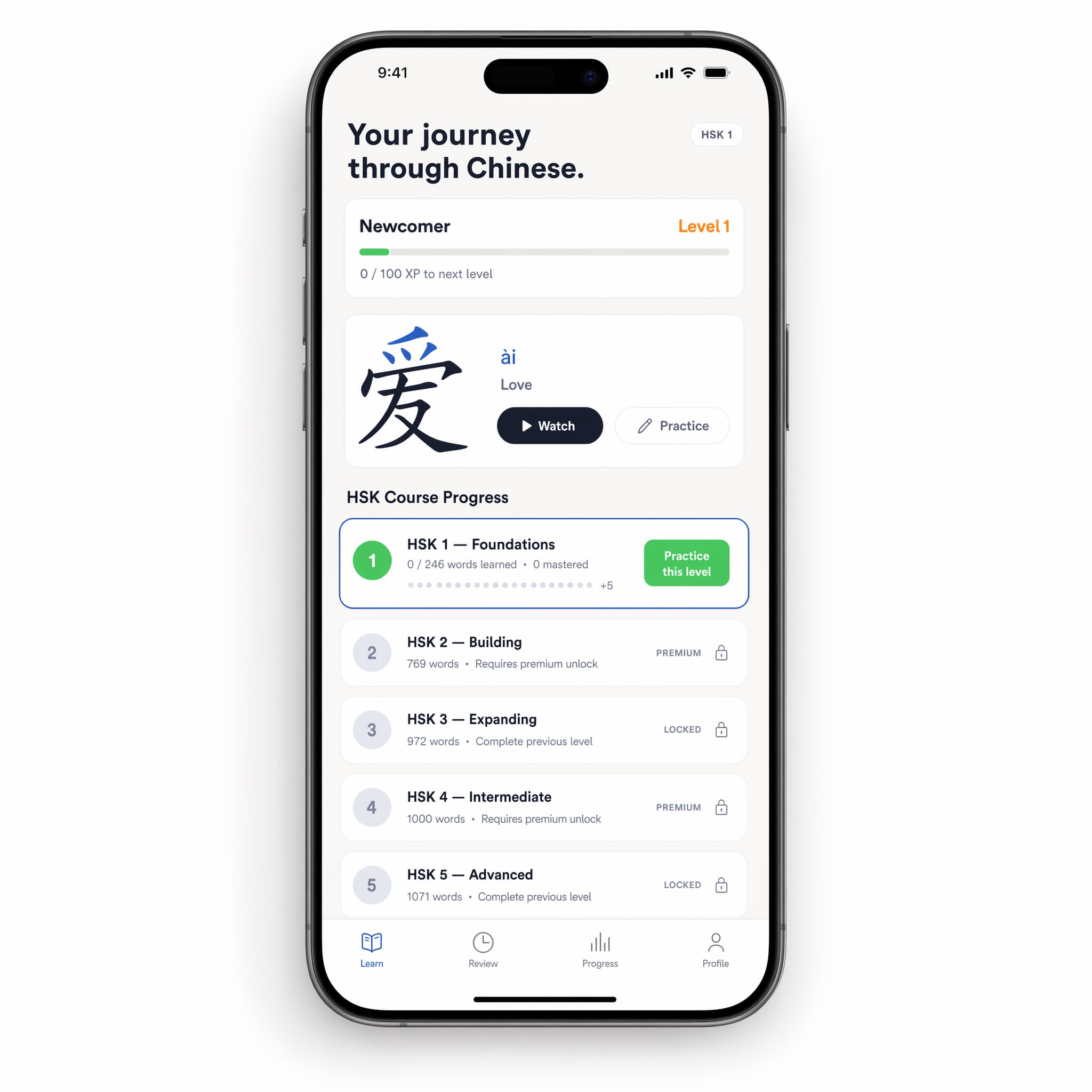
We also wanted the written language to feel less opaque. Characters are treated as built forms rather than abstract symbols: stroke order is shown clearly, writing can be practiced directly on screen, and feedback reinforces structure as much as recall. Alongside that, the experience is organized around established proficiency levels, so the challenge keeps pace with the learner without tipping into confusion.
Ultimately, MyChinese is a tool for transition. It is meant to take someone from memorizing lists in isolation to understanding the language in motion: in conversations, in media, and in the texture of everyday life. The goal is not more drills for their own sake, but a more confident, meaningful kind of immersion.